





 Add to Cart
 Calculate delivery
Product Description
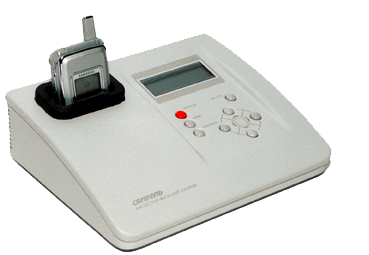
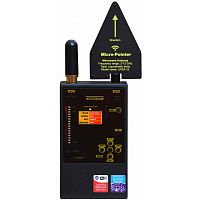
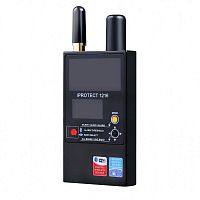
ST 168 Cellular and Wireless Data Blocker Tester
designed for monitoring the radiation level of blockers (jammers) of CDMA 450, GSM, 3G, DECT, WLAN, BLUETOOTH standards
Allows you to determine the actual suppression zone and compliance with the frequency ranges of the controlled standards.
Easy to use. Prompt receipt of results.
Algorithm of operation:
- measurement, processing and display of the radiation level of base stations and blockers of the selected standard in numerical and graphical form
- Display of the verification result as an information line.
Product Features:
- Selective reception of radio signals in the frequency ranges of the selected standards.
- Comparison of base station signals and blocker signals
- Selecting and setting the suppression factor
THE USE OF THE PRODUCT IS BASED ON THE FOLLOWING PREREQUISITES:
The GSM and 3G standards have frequency-separated reception and transmission paths.
The cellular communication blocker creates interference in the frequency range of the receiving part of the mobile device (handset).
For reliable suppression of cellular communication between the base station and the handset, the signal level of the blocker (jammer) must exceed the level of the base station signal received by the handset by a certain amount. In the GSM-3G ST168 blocker tester, this value is called the "Suppression Coefficient".
The actual GSM signal suppression zone, in addition to the level of radiated power, will depend on how far away the blocker is from the base station. The closer it is, the larger the signal from the base station and, accordingly, the smaller the suppression zone. Also, this value is directly affected by the elements of the building – metal structures, walls, etc.
Thus, to assess the effectiveness of the GSM cellular communication blocker, it is necessary to measure the signal level of the base station in the controlled territory and the signal level of the GSM-3G suppressor. In ST168, this is implemented, both numerically and graphically. The graphical representation allows you to evaluate how accurately the frequency range of the blocker-suppressor corresponds to the range of the suppressed cellular standard. Comparing the obtained values with the available value of the suppression coefficient the product ST168 gives a decision on the quality of the GSM signal suppression by the jammer in this place in the form of an information line of the form: "That's enough."
To evaluate the suppression zone, you must move away from the jammer in different directions until the "Not enough" label appears.
The DECT, WIFI, and Bluetooth wireless standards have the same frequency range and no separation of transmission and reception channels. Therefore, in this case, the overall signal level is measured.
TECHNICAL SPECIFICATIONS:
|
Frequency range, MHz |
935-960 (GSM 900 BASE), 1800-1900 (GSM 1800 BASE, DECT), 2125 -2170 (3G), 2400-2480 (WI FI and BLUETOOTH) |
|
Threshold sensitivity, dBm |
935-960 MHz -75 1800 - 1900 MHz - 85 2125- 2170 MHz -77 2400-2480 MHz -66 |
|
Maximum level of the displayed signal, dBm |
10 |
|
Display |
169X128 color OLED display |
|
Internal power supply |
Li-pol acc. battery |
|
Current consumption, mA, max |
210 |
|
Dimensions of the main unit, mm |
90x54x21 |
 Add to Cart
 Comparison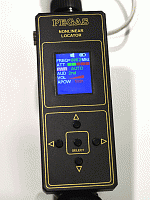

To evaluate the suppression zone, you must move away from the jammer in different directions until the "Not enough" label appears.
The DECT, WIFI, and Bluetooth wireless standards have the same frequency range and no separation of transmission and reception channels. Therefore, in this case, the overall signal level is measured.
TECHNICAL SPECIFICATIONS:
|
Frequency range, MHz |
935-960 (GSM 900 BASE), 1800-1900 (GSM 1800 BASE, DECT), 2125 -2170 (3G), 2400-2480 (WI FI and BLUETOOTH) |
|
Threshold sensitivity, dBm |
935-960 MHz -75 1800 - 1900 MHz - 85 2125- 2170 MHz -77 2400-2480 MHz -66 |
|
Maximum level of the displayed signal, dBm |
10 |
|
Display |
169X128 color OLED display |
|
Internal power supply |
Li-pol acc. battery |
|
Current consumption, mA, max |
210 |
|
Dimensions of the main unit, mm |
90x54x21 |










Copyright 2008-2022 © NAUSHNIKA.NET - The first Online Store of Earpiece. All rights reserved. Pl. de la Duchesse de Brabant 20, 1080 Molenbeek-Saint-Jean, Belgium, |